
Voice-Clone CEO Fraud: When the Boss on the Call Is Fake
"In forty years I have reset a great many passwords. You cannot reset a voice. That is what makes this the most personal fraud I have seen in my career, because the deepfake on the call is not a stranger pretending to be the boss. It is the boss, down to the breath between words."
James Houghton, Chief Executive Officer, Phishing Tackle
A finance manager takes a call late on a Thursday. It is the chief executive, and the voice is unmistakable. The same slight rasp, the same habit of running two thoughts together when the pressure is on. There is an acquisition that has to close tonight, the lawyers are waiting, and a payment has to reach a counterparty before the banks in Singapore shut. The manager has sat through a hundred meetings with this voice. So the money moves. The only thing wrong with the story is that the chief executive never made the call.
Voice-clone CEO fraud is a scam in which criminals use artificial intelligence to copy a senior person's voice and then phone their own staff, usually someone in finance, with an urgent instruction to move money or change payment details. The clone is built from ordinary public audio: a webinar, a conference talk, an earnings call, a podcast appearance. It matters because it attacks the one check most of us still trust without thinking, which is that we can recognise the voice of someone we know.
Where does the attacker get your voice?
You gave it to them, in the most reasonable way possible. Anyone in a senior role leaves a trail of recorded speech behind them, because that is part of the job. A results webinar sits on the company website. A panel talk is up on YouTube. A podcast host has you for forty minutes of clear, well-recorded audio. None of that was careless. It is exactly what a visible leader is supposed to do.
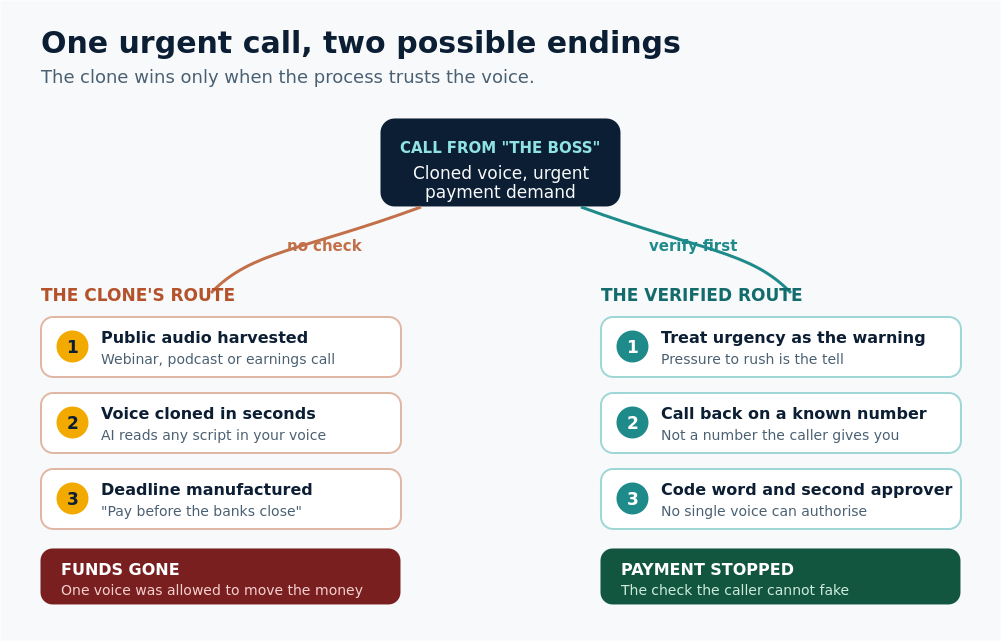
The uncomfortable change is how little of it a criminal now needs. A few years ago, cloning a voice convincingly took a studio's worth of samples. Today the commercial tools advertise a usable clone from under a minute of clean audio, and public reporting on the current wave of scams puts the figure at seconds rather than minutes (see CNN's reporting on the rise of voice-cloning scams). The clone can then say anything the attacker types. It will hesitate in the right places. It will sound tired at the end of a long day. It does not need to be perfect for the whole call, only for the thirty seconds it takes to sound like you and create a reason to hurry.
Why does a call from the boss still work?
Because it uses two things that have very little to do with technology. The first is authority. When the most senior person in the building asks for something directly, the instinct of a good employee is to help, and to help quickly. The second is urgency. Every version of this scam manufactures a deadline: a deal that collapses at midnight, a supplier about to walk, a regulator who needs an answer now. Urgency is designed to stop you doing the sensible thing, which is to slow down and check.
Finance teams are the target for a simple reason. Their job is to be responsive and to make payments happen. A scam that punishes helpfulness is a cruel one, and that is rather the point. This is not a failure of intelligence or diligence. It is a well-built confidence trick aimed squarely at people who are doing their jobs properly.
Has this actually happened, or is it just a demo?
It has happened, and the sums are not small. In early 2026 the Swiss broadcaster SRF reported that an entrepreneur in the canton of Schwyz was talked into transferring several million Swiss francs to an account in Asia after a series of phone calls, over about two weeks, from what he believed was a trusted business partner. The voice was a deepfake, and the case is now under investigation. What stands out is the patience. This was not a single panicked call but a relationship, built and maintained by a machine.
The landmark case is still the engineering firm Arup, which in 2024 confirmed it had lost about twenty-five million US dollars after a finance employee in Hong Kong joined a video call where the chief financial officer and several colleagues were all AI fakes (reported by CNN). That one added a fabricated face to the fabricated voice. Voice-only fraud is the cheaper, more scalable cousin, because a phone call needs no webcam, no lighting, and no lip-sync. It travels down the oldest channel we have.
The part almost everyone gets wrong
Ask people how they would spot one of these calls and most will say the same thing: they would just know. They would hear something off in the voice. For most of my career that confidence was justified, because the audio really was the giveaway. A bad impression fell apart in seconds.
That is the assumption the current attacks quietly break. The voice is no longer the weak point in the con. It has become the strongest part of it. Which means the thing we have leaned on for decades, our ear for a familiar voice, is exactly the thing that can no longer be trusted on its own. Think of it like a handwritten signature. For years it worked as proof because forging one well was hard. Once anyone can reproduce it perfectly, you stop trusting the signature and start trusting a countersign that the forger does not have. The same shift has now reached the human voice.
What actually helps
The good news is that the fix is old and unglamorous, and it does not depend on catching the fake by ear. It depends on refusing to let a voice, any voice, be the final authority on moving money.
For individuals, the single most useful habit is to treat urgency as the warning sign rather than the instruction. If a call pushes you to act before you can verify, that pressure is the tell. Hang up and call the person back on a number you already have, not one the caller gives you. Agreeing a private code word with close family and with a handful of key colleagues is a simple, effective step, and it is precisely what the FBI recommends in its guidance on AI-enabled fraud (FBI Internet Crime Complaint Center).
For organisations, the work is to build the check into the process so no one has to be a hero. Payments above a sensible threshold should need out-of-band verification and a second approver, so that one convincing phone call is never enough on its own. Make it culturally safe to pause a request from the top, and say so out loud, because a finance clerk who fears looking difficult is the person the scam is counting on. Rehearse it. A short, realistic drill where staff receive a mock urgent call teaches the reflex far better than a policy document nobody reads. And when someone does stop a suspicious payment, treat it as the win it is. People are not the weakest link here. Given a clear procedure and the permission to use it, they are the last and best line of defence, the one part of the system a clone cannot talk its way past.
Key takeaways
- Voice-clone CEO fraud copies a senior person's voice from public audio and phones staff with an urgent instruction to move money.
- Modern tools need only seconds of clear audio, so any leader with a webinar or podcast online can be cloned.
- The scam runs on authority and manufactured urgency, not on technical trickery, and finance teams are the usual target.
- Real losses are confirmed, from a several-million-franc case reported in Switzerland in early 2026 to the twenty-five million dollar Arup fraud in 2024.
- The voice can no longer be the final check. Verify on a known number, agree a code word, and require a second approver for payments.
Frequently asked questions
How much of my voice does someone need to clone it?
Far less than most people expect. Commercial tools now claim a convincing result from under a minute of clean speech, and reporting on current scams points to just seconds. A single public talk or podcast is more than enough raw material.
Can I tell a cloned voice from the real one by listening?
Increasingly, no, and that is the uncomfortable heart of it. Some clones still slip on background noise, odd pacing or an unusual word, but you should not stake a payment on hearing the flaw. Verify through a separate channel instead of trusting your ear.
Is this the same as the deepfake video calls in the news?
It is the audio-only version of the same idea. A faked video call, like the Arup case, adds a synthetic face, which is more work for the attacker. A voice clone needs only a phone line, which makes it cheaper and easier to run at scale. We cover the video side in our piece on deepfake CFO fraud.
What is the one control that helps most?
Out-of-band verification. Before any unusual or urgent payment goes out, confirm it through a channel the caller does not control, such as calling the person back on a number you already hold. Pair that with a second approver and no single voice can authorise the transfer.
How is this different from business email compromise?
It is the same crime wearing a new disguise. Business email compromise impersonates a trusted person in writing. Voice cloning does it out loud, which many people find harder to doubt because a familiar voice feels like proof.
Phishing Tackle offers the tools businesses need to strengthen their human risk strategies, with multi-platform testing, real-time behavioural insights, and actionable data to keep your organisation ahead of modern cyber threats.
Contact us today to learn how Phishing Tackle can help safeguard your organisation from the growing array of cyber risks.
