
Spear Phishing Just Got Automated, and Cheap
Spear phishing has always had a bottleneck, and the bottleneck was a person. Working out who a target reports to, which project they are on, which supplier they deal with and how their colleagues write to them takes hours of research per victim. That cost is the reason targeted messages were mostly reserved for finance directors and system administrators, while everyone else received the generic "your mailbox is full" template that security teams have been training staff to spot for a decade.
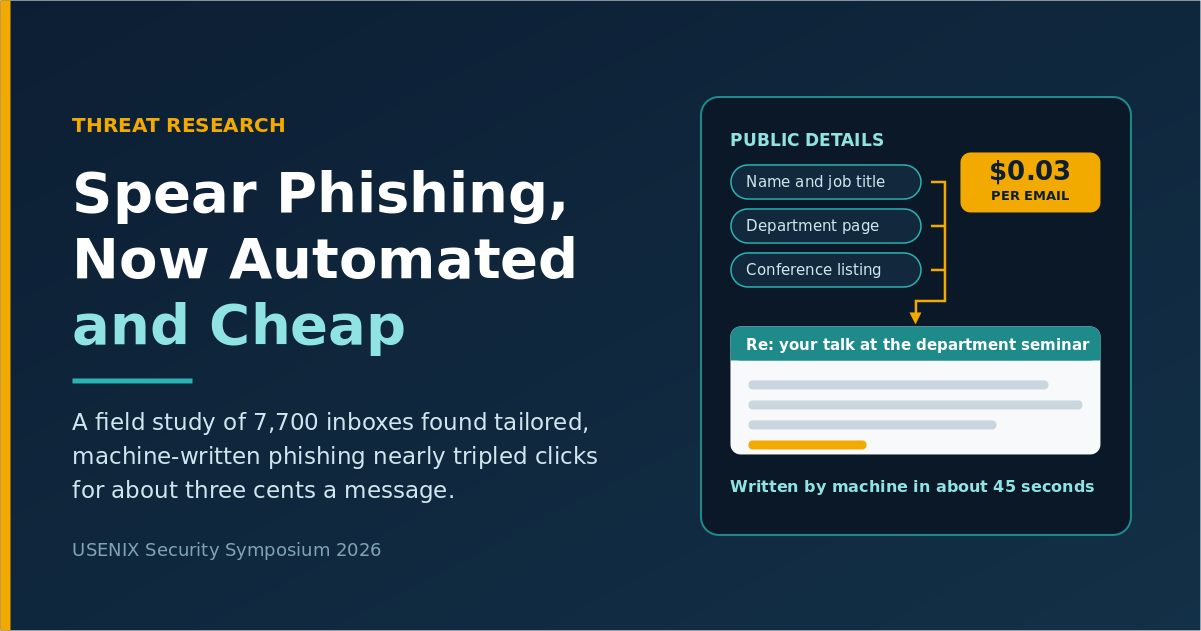
New research presented at the 35th USENIX Security Symposium in Baltimore this month suggests that bottleneck has quietly disappeared. A team from BIFOLD and TU Berlin, Inria and Ruhr University Bochum built an automated pipeline that turned a plain email address into a tailored phishing message, sent the results to 7,700 people, and measured what happened. Personalised messages nearly tripled the click rate compared with generic ones, at a cost of roughly three US cents each.
What the researchers actually did
The study, "A Large-Scale Study of Personalized Phishing using Large Language Models", was run inside a partner university's existing phishing awareness programme, in coordination with the institution's data protection office, security team and administration. That matters, because it means the click rates come from real inboxes during a real working week rather than from a laboratory exercise.
The pipeline had three stages. Starting with nothing but an email address, it ran a web search to collect whatever public information existed about that person. A language model turned those search results into a short profile. A second model picked a plausible sender and wrote a message tailored to the profile. The whole chain ran on open-weight models hosted locally, including variants of Llama, DeepSeek, Gemma, Mistral and Phi, deliberately avoiding commercial cloud services so the attack would leave no trace with a provider. The pipeline produced 4,010 emails at roughly 45 seconds each on a single GPU, around nine times faster than the human baseline the researchers measured.
The numbers, and what they mean
Four approaches were compared side by side. Manually written generic phishing reached a click rate of 4.1 per cent. Generic phishing written by a language model did slightly worse, at 3.7 per cent. Automated spear phishing reached 10.0 per cent. Spear phishing written by hand for a small group of 100 recipients was the most effective of all, at 24.2 per cent.
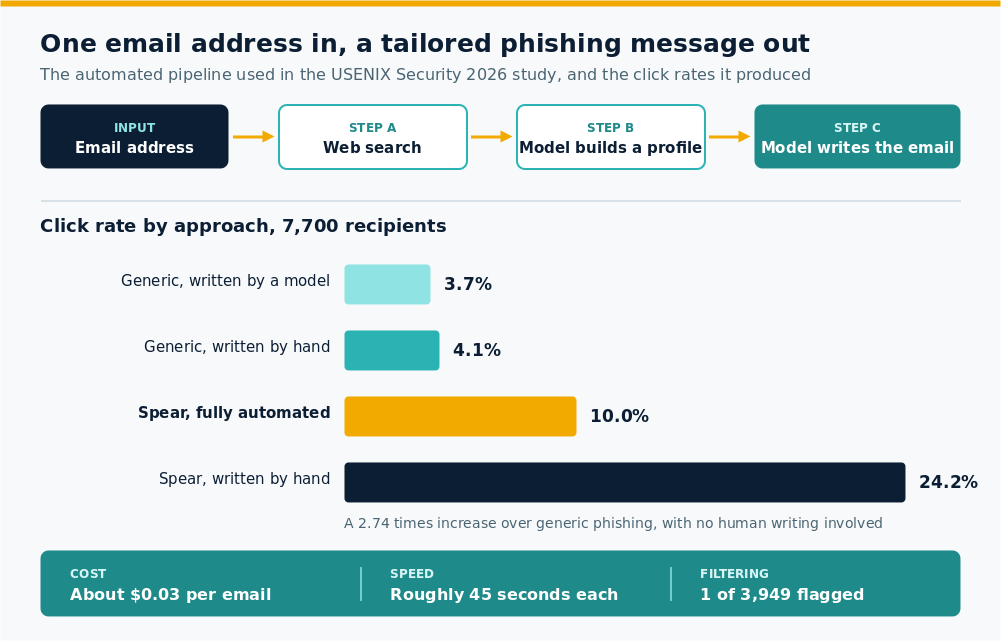
Read those figures carefully, because the interesting result is not the top line. Employees at this university were already reasonably good at ignoring templated messages, whether a human or a model wrote them. What they had not been prepared for was a message that knew something true about them. Automation produced a 2.74 times increase over generic approaches while requiring no human curation at all, and the total bill for generating those 4,010 messages came to about $120, which works out at less than $0.03 each including search, inference and generation.
The human-written comparison group is worth holding onto as well. A skilled person still writes a better phishing email than the models did here. The gap between 10.0 and 24.2 per cent is the headroom that improving models are likely to close over the next few years.
Why the usual warning signs did not help
Two findings should give any security team pause. The first is technical. Across the campaigns, the university's commercial spam filter and unified threat management system flagged one message out of 3,949. Emails that read like ordinary human correspondence, reference real details and arrive from a credible-looking sender do not contain much for a content filter to grip.
The second is behavioural. In a small follow-up survey, recipients of the personalised messages reported feeling very little pressure to click. Only 19 people completed the questionnaire, so the researchers treat this as a descriptive observation rather than a statistical finding, but it points at something uncomfortable. Most phishing advice teaches people to look for urgency, threat and pressure. A message that simply sounds like a colleague referencing a real project has none of those tells.
The surprise: more public information meant fewer clicks
The result that most people find counterintuitive is what happened to the people with the largest digital footprints. Recipients were split into groups by how much public information the pipeline could find about them. The low and medium groups clicked at 12.7 and 12.1 per cent. The high-information group clicked significantly less often.
The explanation is a limitation of the technology rather than a virtue of the targets. When there is very little source material, the model reuses the few real details it found, producing a short but accurate profile. When there is a great deal of material, it summarises and paraphrases more heavily, and the specific details that make a message land get diluted or drift into invention. A modest professional footprint, a departmental page and a conference listing, turns out to be close to the ideal input. Nobody is out of scope on the grounds of being unremarkable online.
What this changes for defenders
None of this makes phishing unstoppable, and it is not an argument for asking staff to try harder. The NCSC has said for years in its guidance on defending your organisation from phishing that no training package can teach anyone to spot every phishing attempt, and that blaming people who click does not change the outcome. Research like this strengthens that position rather than weakening it. The practical response is to spread the load across several layers:
- Assume some messages will be clicked, and reduce what a click is worth. Least privilege, network segmentation, phishing-resistant multi-factor authentication on anything that matters, and fast isolation of an affected account turn a bad afternoon into a contained incident.
- Update what your training actually shows people. Examples built around spelling mistakes and urgent threats no longer represent the harder end of the threat. Staff need to have seen a calm, accurate, personally relevant message that is still a phish.
- Shift the reported behaviour from "spot it" to "verify it". An out-of-band check through a known channel works regardless of how convincing the message was, which is exactly why it survives better prose. Our note on building a reporting culture covers how to make that the default.
- Look at your organisation's public footprint with an attacker's eye. For universities, councils and professional services firms, publishing names and roles is part of the job and removing them is not realistic. Trimming the unnecessary extras is, and it reduces the structured, linkable material available for automated profiling.
- Count the reports as well as the clicks. If your only metric is failure, you are teaching people that the safe move is silence.
The bottom line
The economics of targeted phishing have changed, and the study puts a number on it. Personalisation used to be expensive, so it was rare. At three cents a message it is now a default setting rather than a special effort, and the researchers point out that their use of small local models makes their figures a lower bound rather than a ceiling.
For most organisations, the useful takeaway is not alarm. It is that the version of phishing your people were trained to recognise is no longer the version most likely to reach them. Awareness programmes that still lean on bad grammar and false urgency are teaching a threat that is fading, while the one that is growing looks entirely ordinary. Updating the examples, backing them with technical controls that assume the occasional click, and making verification easy is a realistic answer to a problem that no filter is going to solve on its own.
Phishing Tackle offers the tools businesses need to strengthen their human risk strategies, with multi-platform testing, real-time behavioural insights, and actionable data to keep your organisation ahead of modern cyber threats.
Contact us today to learn how Phishing Tackle can help safeguard your organisation from the growing array of cyber risks.
